An interview with… Santiago Roncagliolo

Santiago Roncagliolo at the IFFP ceremonyHere is my interview with Santiago Roncagliolo for Booktrust:

In the busy hub of Foyle’s cafe, I meet the winner of this year’s Independent Foreign Fiction Prize, Santiago Roncagliolo. In spite of the building publicity surrounding the Prize over the past few weeks, it is unlikely that any of the other cafe goers would think twice to look at Roncagliolo. A Peruvian-born writer, he moved to Spain ten years ago and his political thriller Abril Rojo (Red April) was awarded the prestigious Spanish literary prize the Premio Alfaguara de Novela in 2006. However, until last Thursday, he has remained, relatively unknown elsewhere in Europe. Now at the age of just 36, he has triumphed once again and has become the youngest ever recipient of the IFFP for Red April.

Published on 31-05-11. Read on here

Mexico’s drug war is a global crisis

Mexico guns

Here is my latest article published in Prospect:

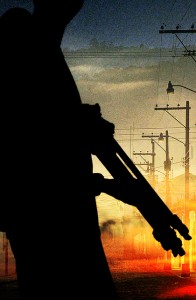
On Sunday morning, 27 people were killed and beheaded in northern Guatemala following a raid on a dairy ranch in Caserio La Bomba. The incident has been described as the worst massacre in Guatemala for over 15 years. Amid growing suspicion that the attack may be linked to the rising presence of the Mexican Zeta drug cartel in Guatemala, the massacre may also point to the wider responsibilities of Mexico’s drug war.

Published on 19-05-11. Read on here

Brazil stands up to its guns

Brazil-guns-218x300

Here is my first article published in Prospect:

On 7 April, 23-year-old Wellington Menezes de Oliveira entered a school in Rio de Janeiro brandishing a gun. He killed 12 students and injured more than 20 others before shooting himself. Although Brazil has become increasingly associated with violence and gun crime in recent years, this was the first time in the country’s history that a school has been the target of a shooting, drawing comparisons with the 1999 Columbine massacre.

Published on 06-05-11. Read on here

Decades of neglect led to this Northern Ireland water crisis

northern ireland water

Here is my latest article published in the Guardian:

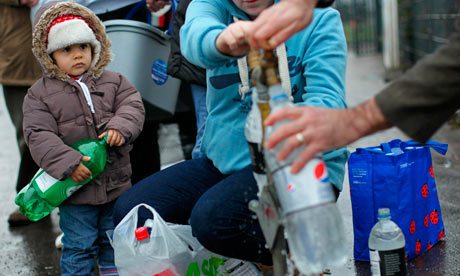
Witnessing thousands queue in the cold and dark over the past two nights to collect water from depots across Northern Ireland, I’ve found it hard to understand how things could have gone this far. One member of the public described it as “scandalous”, a second as “unacceptable”, while others are speechless as to how to describe the current water crisis that has left about 80 towns and 36,000 homes without running water. Understandably, the public are angry and want somebody to blame. However, the crisis reveals more than just a lack of a foresight, but also longstanding neglect.

Published on 30-12-10. Read on here

The dramatic rescue of Los 33

In probably one of the most nail biting rescues in modern-day history, the world watched rapt as the 33 Chilean miners reached the surface safely yesterday.

In spite of allegations earlier this week that some broadcasters were providing excessive coverage of the rescue, the age of live internet streaming and Twitter succeeded in uniting support worldwide for the Chilean miners and their families.

The miners have been trapped underground for over two months after a rockfall caused a tunnel at the San José mine to collapse on 5 August. The miners have survived by receiving food, water and other supplies down a borehole.

Many of the men’s family and friends set up camp near the mine and the media has been covering events closely. It is remarkable how the lives of these 33 ordinary men have now become public knowledge, not only on a national, but an international scale.

President Sebastián Piñera was present from the very beginning of the excavation operation and has received a number of phone calls from heads of state around the world. On the telephone with David Cameron, he thanked the British Prime Minister for his call. “Let’s share a cup of tea next week when I am in London,” he added, smiling.

As the operation proceeded successfully, the air of tension gradually changed to excitement as we were greeted with scenes of jubilation and it seemed increasingly likely that all of the miners would be rescued and brought to safety. “Vamos, Vamos, Vamos!” (Go, go, go!) yelled Mario Sepúlveda, the second miner to be rescued, as he neared the surface. He handed out stones to the rescue team as souvenirs.

Despite a dent in the “Phoenix” capsule’s door, the elaborate operation progressed well and mining minister Laurence Golborne reportedly said that the rescue had gone much faster than expected. The last miner, 54-year-old Luis Urzua,  emerged at the top of the rescue shaft at 21 55 yesterday local time.  The last rescue worker Manuel González was lifted to safety at 00 55 this morning local time. The entire operation took just over 24 hours to complete – less than half that originally expected.

There are of course concerns over the men’s health and psychological well-being after being stuck underground for such a long period of time. They are due to remain in the nearby Copiapó hospital for at least 2 days as doctors run a number of medical and psychological tests on them. Many of the men are believed to be suffering from severe dental problems.

It’s been a tough year for Chile, having suffered an earthquake registering 8.8 on the Richter scale and the large-scale Mapuche hunger strike. So it’s about time that the country had a reason to celebrate.


By continuing to use the site, you agree to the use of cookies. more information

The cookie settings on this website are set to "allow cookies" to give you the best browsing experience possible. If you continue to use this website without changing your cookie settings or you click "Accept" below then you are consenting to this.

Close