Alexander Solzhenitsyn: 'the ultimate realist writer'

Here is my latest blog for Booktrust:

Alexander Solzhenitsyn

Alexander Solzhenitsyn was born in Kislovodsk in the south of Russia on 11 December 1918. On the anniversary of his birth, I am looking back at the life and works of one of Russia’s greatest writers.

Solzhenitsyn was born into a family of Cossack intellectuals and studied Mathematics and Physics at the prestigious Rostov University in southern Russia. He went on to serve as an artillery officer in the army and despite growing up as a staunch supporter of the Soviet regime, he increasingly voiced his concerns over Stalinist policies. One day in 1945, a letter, in which he had openly criticised Stalin, was found and he was immediately denounced. He spent the next eight gruelling years in a gulag prison. Lucky to survive the ordeal, he was then internally exiled to Kazakhstan.

Published on 10-12-10. Read on here

Amazon’s award sponsorship gets publishers in a flap

Here is my latest blog for Booktrust:

The Best Translated Book award was set up in 2007 by literary organisation Three Percent, so-called because of the paucity of translated works published in the US, which is estimated at just 3% of the total number of books published there every year. To date, the BTB award has offered no cash prize. However, Amazon recently announced its decision to provide $25,000 (£15,000) worth of funds to cover promotional costs and grant cash prizes for the winning entries. That’s $5000 for every author and translator.

Published on 11-11-10. Read on here

Brazil elects Dilma Rousseff as first female president

After weeks of speculation, Dilma Rousseff has been elected president of Brazil. 62-year-old Ms Rousseff has never held elected office before but was voted in yesterday as the country’s first female president.

After a bitter fight to the end in which both sides accused one another of corruption and misconduct, Rousseff, of the governing Working Party, won 56% to 44% against her rival José Serra, a candidate for the Social Democrat’s Party.

She was always tipped as the ideal successor of outgoing President Luiz Inacio Lula da Silva and enjoyed his support throughout the campaign. He was always praised as an ambassador of the poor and leaves office after two terms with a sky-high popularity rating.

In her victory speech, Rousseff announced that one of her first priorities would be to “eradicate poverty” and pull 20 million Brazilians out of poverty. She hopes to build on Lula’s achievements, since under his government the country witnessed increased minimum wage, increased per capita income and reduced unemployment.

Rousseff’s victory is also a huge victory for the left across Latin America. Washington is unlikely to welcome the news, since, in spite of efforts to cooperate more closely with Latin America than his predecessor, Obama’s administration has continued Bush’s “rollback” strategy against the rise of the leftist governments in the continent over the past decade.

On another level, her victory also points to the ascendancy of female politicians throughout the continent. Of the major countries alone, Argentina has already had two female presidents, Isabel Peron, the first woman to become president of a republic, from 1974 to 1976, and Cristina Fernandez de Kirchner, who has been in power since 2007. In Chile, Michelle Bachelet ruled from 2006 until March 2010. Now Brazil has its first female president.

Does this spell the end for kirchnerismo?

The sudden death of former Argentine president Néstor Kirchner last Wednesday was a shock to the nation and poses many questions for the future of Argentine, and indeed, Latin American politics.

Swept into his role as president by default in 2003, Kirchner became Argentina’s leader at a particularly difficult time in the country’s political and economic landscape: his three predecessors had come and gone in a five-year period, unemployment had risen to above 21% and the economy, buckling under the pressure of sovereign default on $95bn and colossal devaluation, had well and truly collapsed.

Although he certainly benefited from several inherited policies, Kirchner faced some of the country’s economic challenges head on and became a veritable symbol of Argentina’s economic recovery. He was determined to defy both Washington and the International Monetary Fund’s economic and security policies which, in his opinion, had been the root cause for the country’s economic collapse. In doing so, he prioritised the revival of Argentina’s economy over the demands of foreign creditors. His gamble paid off, stimulating economic growth by some 8% in 2008 and brought over a quarter of the population back above the poverty line.

He also earned support from the left for reopening human rights trials against amnestied officers from Argentina’s dictatorship from 1976-1983. However, he was a deeply divisive figure, much loved by the poor but many of his Peronist policies and allegations of corruption and embezzlement made him unpopular with the conservatives and the upper classes. When he decided to stand down in 2007, he chose his wife Cristina Fernández de Kirchner as his successor. However, Néstor remained active in politics, he became the chairman of the Peronist party, the secretary general for the South American regional grouping, Unasur and his wife’s chief political strategist. It was widely speculated that Néstor himself would stand again in 2011 and that the Kirchners would continue to alternate the presidency for the good part of a decade.

In spite of any controversy, together the Kirchners undoubtedly represented and lived up to the legend of Argentina‘s original “power couple” Juan and Eva Perón. Those that say that his death has created a power vacuum in Argentina are wrong, if anything the power vacuum lies in Peronismo or even kirchnerismo itself. Although a skilful and experienced politician in her own right, the death of her key political confidante will pose problems for her future leadership and weaken her hold on power. Her party already suffered a major setback in the midterm elections last year when it failed to secure a victory in the province of Buenos Aires, a traditionally Peronist stronghold.

Her husband’s death may win her back support in the form of sympathy, but it has also weakened her party irremediably as an internal power struggle rages on. She now has several months to decide if she wishes to opt for a second term. Given the tumultuous nature of the country’s recent political history, during which few of her predecessors succeeded in serving a second term, it is important that she maintains the stability that both she and her husband have created in the Argentine political landscape.

Outside of Latin America, it is perhaps hard to fully comprehend the gravity of Kirchner’s sudden death and its impact on Argentina and the continent as a whole. Often dubbed the “Clintons of the South”, perhaps the most apt modern-day comparison would be if one of the Clintons were to die whilst still politically active.

Kirchner was extremely popular throughout Latin America, winning much support from leftist nations such as Brazil, Venezuela, Ecuador and Bolivia. For Venezuelan President Hugo Chávez, Kirchner’s death marks the loss of one of his most influential political allies in the region and will surely make things more difficult for him amidst waning popularity, having won his country’s recent elections with a much reduced majority. Although the left is prospering in some countries, if Dilma Rousseff’s victory in the Brazilian elections is anything to go by, certainly Kirchner´s death will be a major stumbling block for the future of the left across Latin America.
Prince Harry drama makes a mockery of the military covenant

the taking of prince harry Sebastian Reid mark lawson

Here is my latest article published in the Guardian:

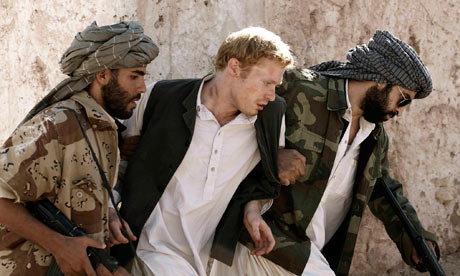
Like Sir Jock Stirrup, I have deep concerns about the drama documentary featuring Prince Harry being captured in Afghanistan that is due to be aired on Channel 4 on Thursday. For people like me, who have close relatives in the armed forces serving in Afghanistan, the documentary makes a mockery of their role out there. Whether you agree or disagree with their continued presence, a fictionalised documentary about a hypothetical situation – a mockumentary if you will – does little to boost the image of British soldiers back home or pay tribute to their sacrifices. Indeed, it does quite the opposite.

Published on 21-10-10. Read on here

By continuing to use the site, you agree to the use of cookies. more information

The cookie settings on this website are set to "allow cookies" to give you the best browsing experience possible. If you continue to use this website without changing your cookie settings or you click "Accept" below then you are consenting to this.

Close